

UX
Project Details
Summary
During the first year of covid-19, interests in nature grew and it lies in a perceived increased need for humans to have access to nature, and to cultivate. Froda will also contribute to sustainable environmental and social development.
Froda opens up opportunities for people to cultivate without having access to their own garden , and give people with gardens the opportunity for garden help. As a result, the app can contribute to a sustainable cultivation culture in the big city.
Conducting interviews to gain information and see how people behave within cultivating and the gardening experience. We received crucial insights to progress in our defining phase.
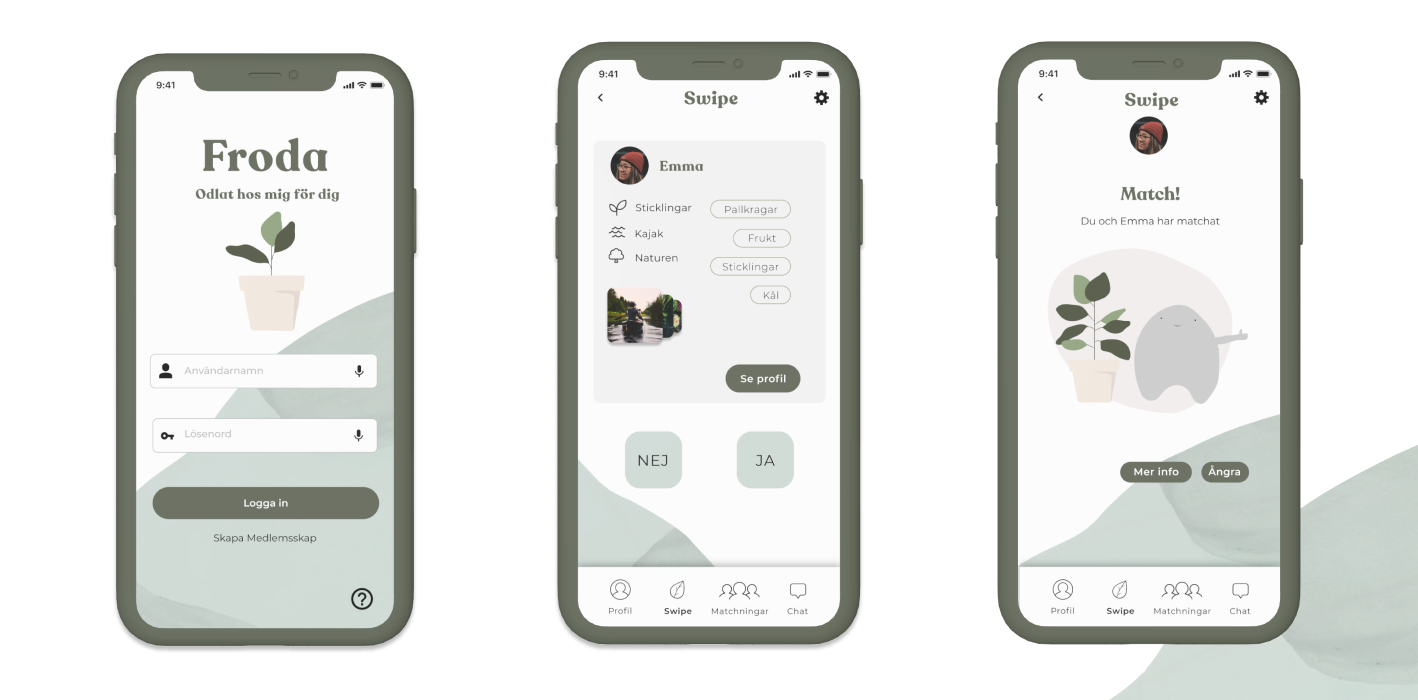
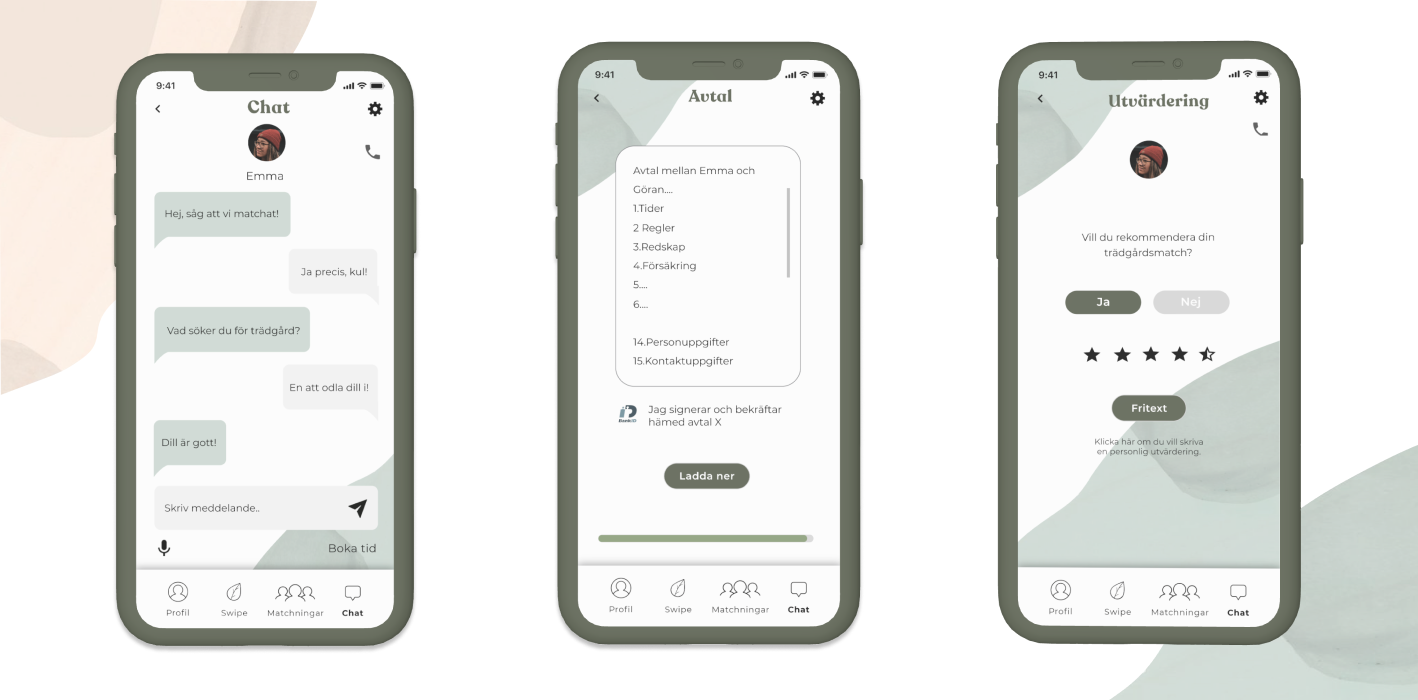
Our solutions were a swipe function like Tinder but with more security steps attached, focusing on the Swedish id-system BankID. After the match and both parties want to continue the agreement they sign contracts between eachother.
The goal of the Froda app is to create a fast, simple and personal match through a swipe function between people who have or are looking for a garden. Froda finds your perfect garden match while contributing to sustainable climate and social development.
Key results: Increased community connection between suburbs and city by 40%, 8/10 users are satisfied with their match.
Browse the prototype and look around to see how users navigate around or continue reading below for my extensive process work and how me and my team went through our decisions in the design process for Froda.
Goals for the project:
Reduced CO2 emissions in Sweden.
Reduced segregation.
Create a sustainable cultivation culture.
Role
Tools
Timeline
Intro
Covid-19 hit hard and people had to change habits and lifestyle. People took their free time to build personal projects and work from home. More people went outdoors and gardening became a big trend. Sales went up from building and construction stores like Byggmax, Bauhaus, and outdoor sports/living store XXL.
We saw a gap in the cultivation community, city people living in small apartments with a need to cultivate. People living in the suburbs with gardens not being taken care of, not having time or the energy to do so.
Froda opens up opportunities for people to cultivate without having access to their own garden , and give people with gardens the opportunity for garden help. As a result, the app can contribute to a sustainable cultivation culture in the big city.
The Team
The team was a new found team with all beginners in the UX field, my team consisted of 4 other people. We all shared responsibilities in our design and research decisions. Our different backgrounds combined made the teamwork great!
Together we developed our first user stories, user journeys and everything business related. Shaping our first ever UX-project.
The Challenge
When Covid-19 hit at the start of 2020, people changed habits and started being home a lot more. Being at home gave people more time to spend in their garden and cultivate more.
But everyone does not have the time or knowledge, while others have the time and knowledge but not a garden to take care of.
We saw an opportunity to develop a community that would grow to contribute to a more sustainable, environmental and social development.
Our challenge is to open up opportunities for people to cultivate without their own garden, and give people with a garden the opportunity to get help. As a result, the app can contribute to a sustainable cultivation culture in the big city.
Bonus challenges : contribute to increased traffic to WWF, reduced CO2 emissions in Sweden, and reduced segregation.

Breaking Down The Process
Understanding The User
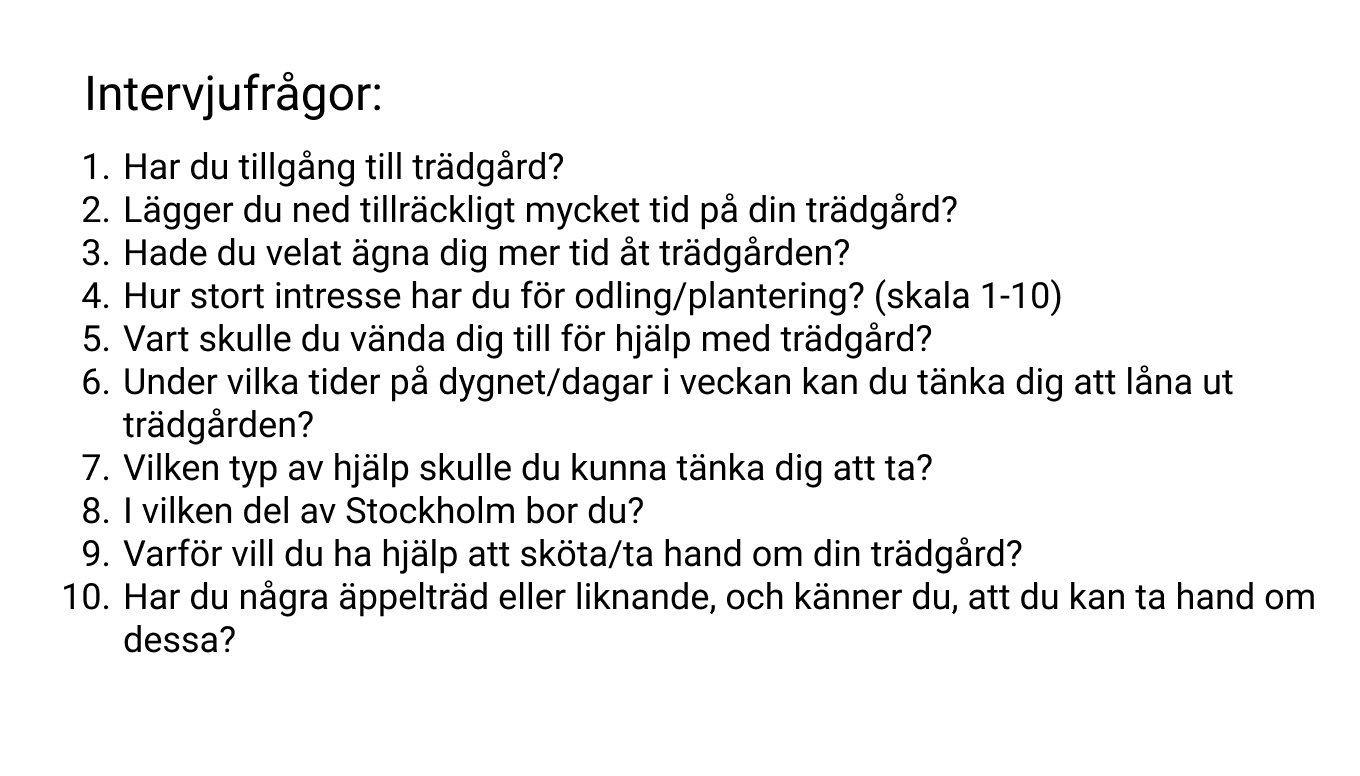
Our team conducted interviews with people from the city and suburbs, gathering information on how our target group feel and think about cultivating. There are two target groups in this project, primary: Users with a garden available for use. Secondary: Users that wish to cultivate, but does not have a garden.
Information from the first interview showed that an app would best suit the user. But we decided to look for other solutions, like facebook groups, local area meetings and a website where users would interact and meet. These solutions opens up for people using the computer, finding us through a search engine.
Out of our 12 interviews, 9 users were highly interested and felt motivated when asked about the future and being able to contribute to a greater cause.
We interviewed the users again after proposing our solution and sent out surveys, that gave us a deeper understanding to the users pain-points and trust issues regarding people and our application.

Synthesizing The Material
Problem Statements
How can we make users feel secure and safe while connecting with other people to develop this cultivating community? A large amount of the survey participants loved our proposed idea and so, our solution would be to develop and app like Tinder, an app where people connect and grow together. But instead of focusing on looks, we focus on nature.


Ideating Solutions
We began sketching on wireframes, taking inspiration from Tinder and Co-grow.
Our idea was that users match with people and their garden, users can then rank each match and then proceed with one user. The two users begin communicating, and if both users want to proceed further, they will sign an agreement between each other and book a time to meet up.
After the users are done with the collaboration, they are free to evaluate and give feedback on how it went.


Validating Design Concepts

Low-Fi Prototypes

Testing Low-Fi Prototypes with users
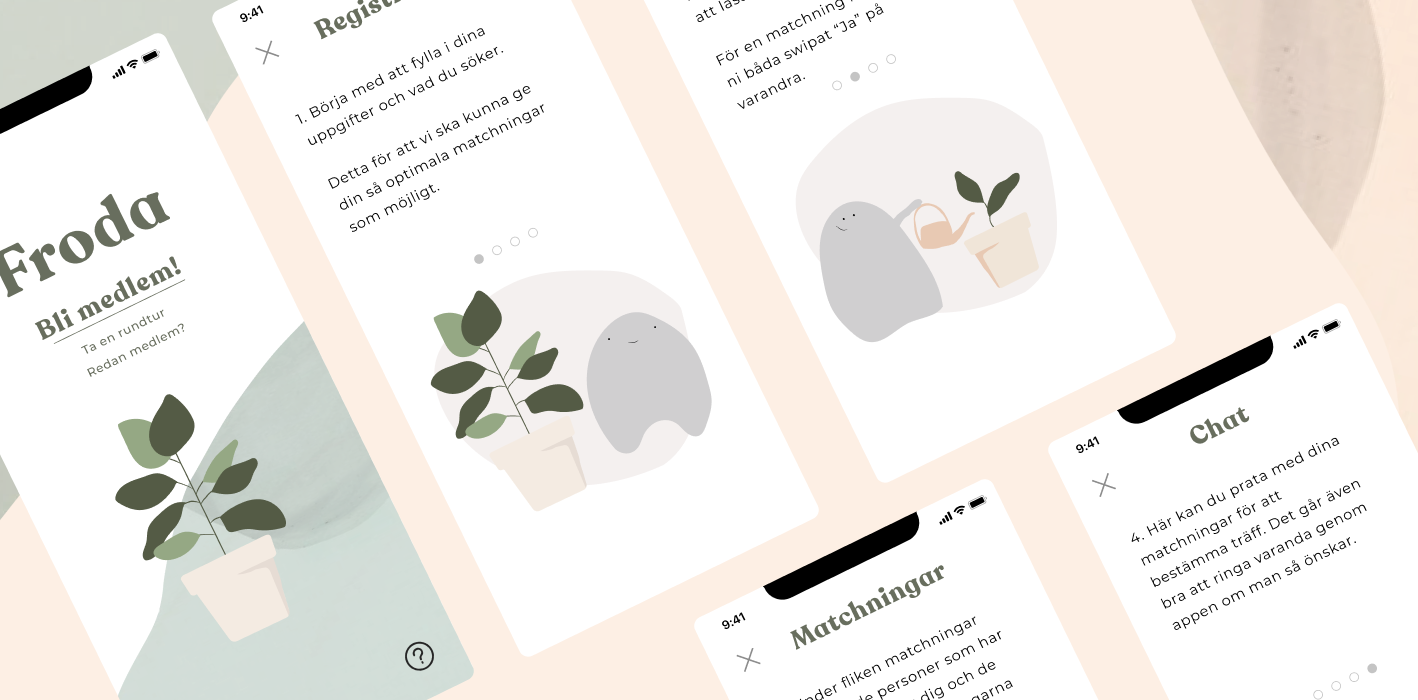
We started to sketch out an onboarding process to ease the user into the application. During our sketching process, we tought about a brand mascot and helper, our illustrator in the team Frida drew Frove. Frove got the answers to all the users questions and needs and helps with the onboarding process.
All the other graphic illustrations in the boarding process are also drawn by Frida.
After testing out the low-fi prototype, we compiled the information into an action list, taking us further in the developing process.
• Onboarding process.
• Button for booking/agreement.
• Ideation phase, refine the flow of the app.
• More clarity on the swipe page and a successful match.
Hi-Fi Prototype Development
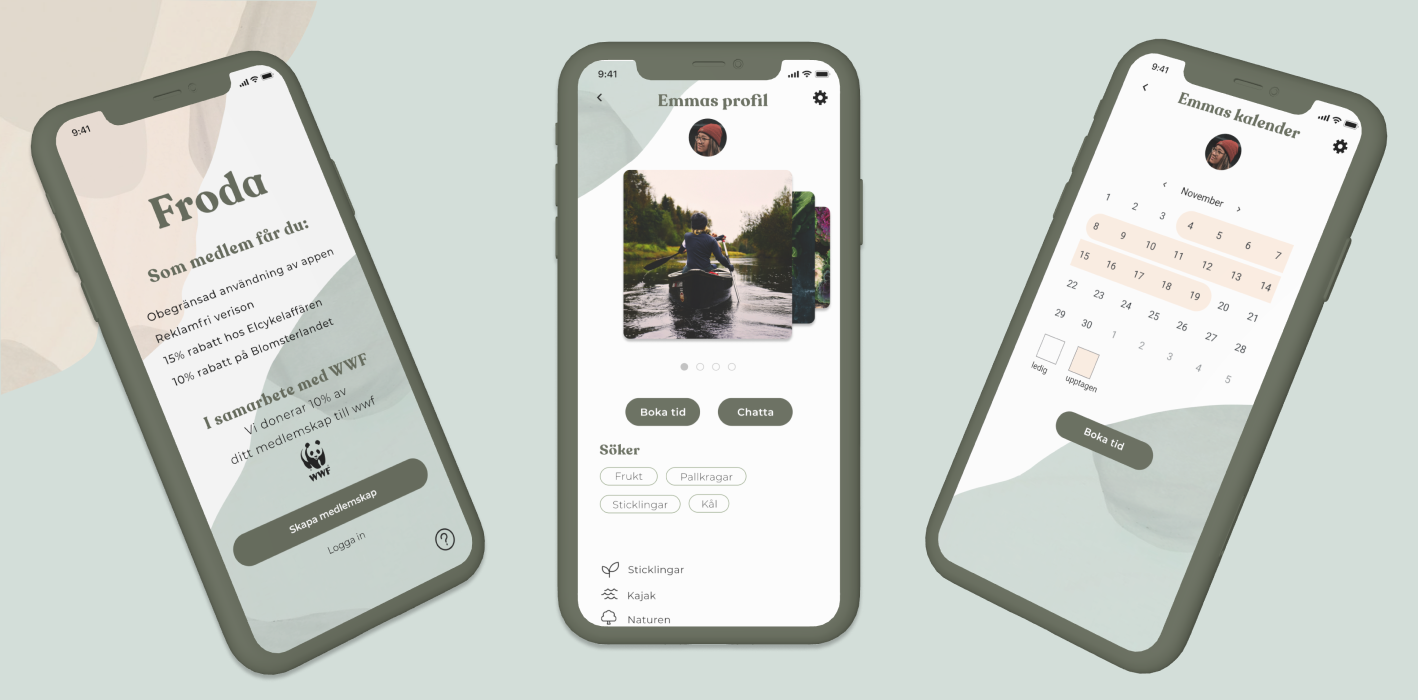
We applied our visual design and branding and sent it out to users for testing. For our final test we refined functions after Nielsen's heuristics.
Giving the user control and freedom to regret matches, defined and streamlined our design to get better consistency and standards.
Results & Impacts
Best thing with Froda is the pleasing design and the thought-out security details!
Froda had a big impact on our team in terms of how it is working together in a UX-project remotely. We developed and gathered a huge amount of knowledge during our 14 weeks together, progressing us further in the education.
Inclusion and ethical design was something we strived to work towards since day 1, but during user tests. We discovered that most of our design choices and functions were not in line with how we wanted to work. We missed out most of the tools for blind/color blindess, impaired motor ability and language barrier.
We managed to develop the choice of language when creating an account.
Major Learnings
First UX-team
In the beginning we struggled to work together due to everyone being new to the UX-field. But as a team we managed to utilize everyones past experiences to progress.
Our bonding and teamwork got better each day.
Research as a team
The research part was something that developed us the most in how we would understand users, since we had developed a clear business plan, model and goals.
We created our first user stories, experiences and requirements.
First UX project
As new UX students it was hard to structure the workflow in the beginning, all the new terms caused confusion. But when we advanced further in the course, learning more and more, and getting to design more. We all felt more comfortable in working on our own and then getting together to evaluate the work.
Keep Learning
I always want to keep progressing towards being better, I found ethics and inclusion design the most interesting.
So my goal now is to deep dive into ethic and inclusion, and try to develop future projects that make a change for people.
Froda in the future
Froda would work really well even after the pandemic, when you once create bonds and a community where people get together, contributing to a better and more sustainable cultivation culture. I don't think people would leave.
Evaluating and change
As a team we could be faster in our decision making, often we would get stuck on small details, also decisions based on WCAG, a lot of our work had to be re done because of not reaching AA level.
Lessons Learned & Going Forward
Being the first UX-project for the team, problems and difficulties came along, and working remotely made it even harder for problem solving. Finding time that suits everyone was a struggle through the whole project, with everyone having other work on the side. But together we managed to recruit users and conduct research at a distance, with the help from social media and relatives. Working remotley also helped us finding time to work on the project, either alone or together.
Most problems occured within Figma, since it was a new program for us. We managed to solve it by asking lots of questions and also learning through youtube, giving us knowledge to use for the next project.
My key takes from this project: Structuring business goals, UX copywriting and styleguides. Those are the things I'm looking forward to get a deeper understanding, for my next project.